Pinellas County is a peninsula with water on three sides, and a large share of its lots sit close to the Gulf, the Sound, Tampa Bay, or a canal. That makes the flood zone on a lot one of the first facts to check before you buy land or sign a design contract. Two lots a few blocks apart can sit in different zones, with different construction rules, different insurance requirements, and different costs.
This article explains the basic difference between Zone X and Zone AE, how each affects a custom home, and what to confirm with the county and your insurance agent. It is general information, not a substitute for the flood map, the county’s floodplain staff, or a licensed agent.
What the zones mean
Flood zones come from the Flood Insurance Rate Maps, or FIRMs, produced by FEMA. They show areas by their risk of flooding. Zone AE is a Special Flood Hazard Area, an area FEMA maps as having a 1 percent chance of flooding in any given year, often called the 100-year floodplain. In AE zones, the map shows a base flood elevation, or BFE, which is the height that floodwater is expected to reach in that 1 percent event.
Zone X is outside the Special Flood Hazard Area. FEMA divides it into shaded X, which is an area of moderate flood risk between the 1 percent and 0.2 percent annual chance flood levels, and unshaded X, an area of minimal mapped risk. Zone X does not mean no risk. Storms, heavy rain, and stormwater backups can flood properties outside the Special Flood Hazard Area, as many Pinellas residents learned in 2024 during Hurricanes Helene and Milton.
Coastal areas also have Zone VE, which is a coastal high-hazard area where wave action is expected. VE has stricter construction rules than AE, and it is not the subject here, but you may find it on parts of a barrier island or open shoreline. FEMA updates maps periodically, so check the current map for your parcel through the FEMA Flood Map Service Center and confirm it with Pinellas County or your city.
How the zone changes the way the house is built
In Zone AE, local floodplain rules require new homes to have the lowest floor elevated to or above the base flood elevation. Many jurisdictions add freeboard, which is extra height above the BFE as a safety margin, and the amount varies by location. Confirm the current requirement for your parcel with the county or city floodplain office rather than relying on a number from a listing or an article.
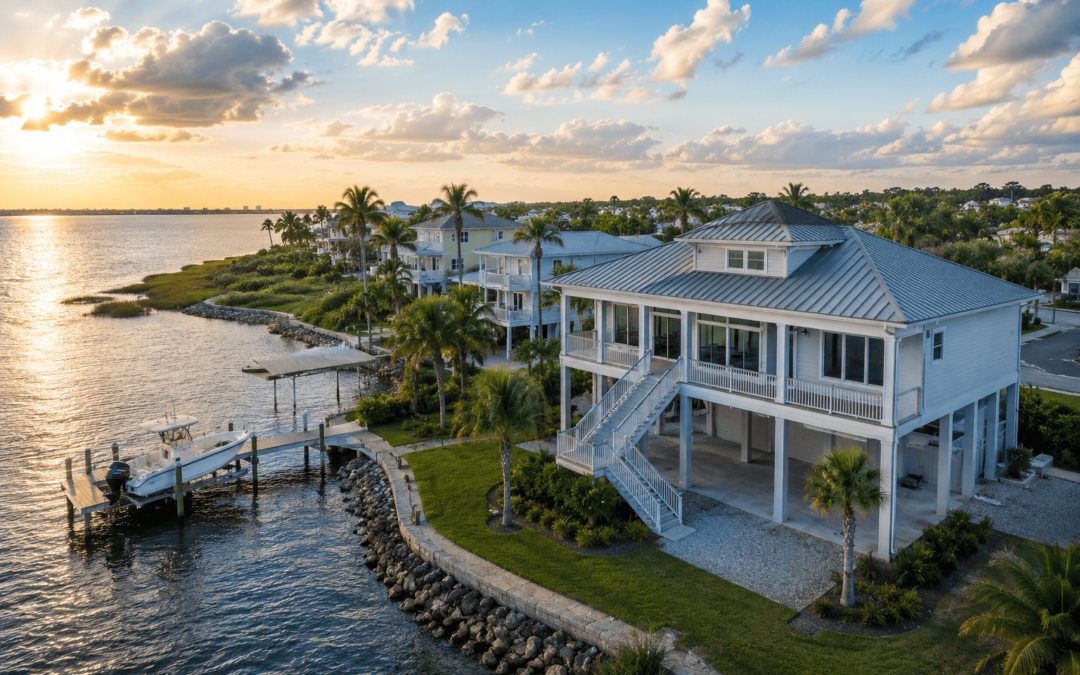
That elevation shapes the house. The foundation may be a raised slab, a stem wall with fill, or piers or columns. Below the lowest floor, the space is typically limited to parking, storage, and building access, and the walls and utilities there are regulated. The stair runs, the garage, the entry sequence, and the connection to the yard all change when the living floor sits several feet above grade. Mechanical equipment is often raised, and flood-resistant materials are used where water could reach.
In Zone X, the flood elevation rules that apply in AE are generally not mandated in the same way, and the house can often sit closer to grade. But that does not mean the elevation does not matter. A local jurisdiction may have its own requirements, and a lot in X can still have drainage problems. Many owners and builders choose to raise the floor beyond the minimum, particularly on a lot that has flooded or sits low. Ask what the county requires and what your builder recommends for the specific site.
The elevation certificate
An elevation certificate is a document prepared by a licensed surveyor that records the elevation of the building relative to the base flood elevation. It is used by the local government to confirm compliance and by insurers to rate flood coverage. For new construction in a floodplain, an elevation certificate is typically required at certain stages and at completion.
You can often get an existing elevation certificate for a house, which is useful when you are evaluating a lot or a tear-down, but the certificate applies to the building that was measured, not to a future home. A new house will need its own. Ask your builder when the certificate is ordered and who pays for it, and confirm what your local jurisdiction requires.
On a lot being redeveloped, there is another rule to know. Local floodplain regulations commonly include a substantial improvement or substantial damage rule, often tied to a 50 percent threshold of the building’s value, which can require an older house to be brought into compliance when it is rebuilt or heavily renovated. Ask the county how it applies to your property.
Flood insurance and your lender
Flood insurance is not part of a standard homeowners policy. It is a separate policy, available through the National Flood Insurance Program and through private insurers. If a property is in a Special Flood Hazard Area such as AE and you have a federally backed mortgage, flood insurance is generally required by the lender. In Zone X, it is generally not required by federal rules, but a lender can still require it, and many owners buy it anyway. Ask your lender what applies to your loan.
Rates depend on the property and the policy. The NFIP uses a pricing approach known as Risk Rating 2.0, which considers more property-specific factors than the zone alone, such as the distance to a water source, the building’s characteristics, and the elevation. Private flood policies are also available, and their pricing and terms differ. Do not assume that a lot in Zone X will be inexpensive to insure or that a lot in AE will be prohibitive. Get quotes.
The best time to talk to an insurance agent is before you buy the lot and again before the plans are final. A good agent who works with Florida coastal properties can tell you how elevation, foundation type, and design choices may affect the premium. Wind coverage is a separate matter, and in Florida it also deserves an early conversation. Features such as impact-rated openings and a code-compliant roof can matter for wind policies, so ask what documentation the insurer will want.
What to do before you buy or build
Start with the parcel. Look up its flood zone and any base flood elevation, then confirm it with the county or city. Ask whether the property has flooded in the past, and walk it after a heavy rain. Order a survey, and talk with a builder and an insurance agent early.
Then build the numbers into your plan. Elevation, foundation type, site work, and insurance premiums all affect the true cost of owning the home, and they are easier to manage when they are part of the first conversation than when they appear at permit review.
If you are considering a lot or a custom home in Pinellas County and want help understanding how the flood zone affects the design and the budget, contact Gulfwind Homes at (813) 854-4715 or visit https://gulfwindhomes.com/. Our main office is at 2264 Bayshore Blvd, Dunedin, and we can walk through your parcel with you before you commit.